
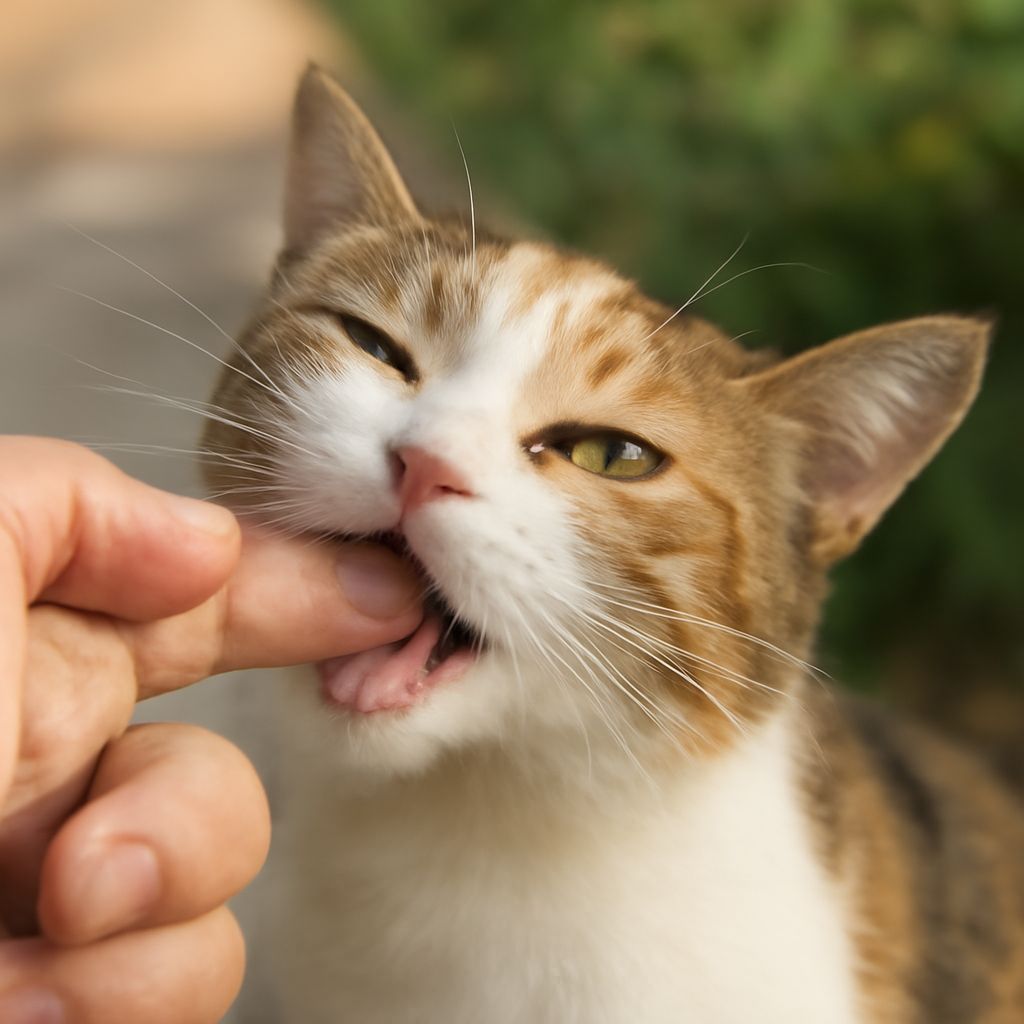
Why Does My Cat Bite Me When I Pet Her? The Real Reasons Behind Love Bites
You’re sitting on the couch, your cat is purring in your lap, everything seems fine — and then she turns and bites your hand. You freeze. Why does my cat bite me when i pet her? It doesn’t seem angry, exactly. It’s not drawing blood. But it’s clearly intentional. Understanding what’s happening here requires thinking less about aggression and more about communication.
The behavior has a name: petting-induced aggression. If you’ve been asking why do cats bite when you pet them, the short answer is that cats have a threshold for touch that varies by individual, by mood, and by location on the body — and when you cross it, they signal you to stop. Why do cats bite you when you pet them differently than dogs do comes down to feline communication styles. And for those wondering why do cats play bite or why do cats bite when they are happy, those are related but distinct behaviors with their own explanations.
Petting-Induced Aggression: Reading the Signals
What Happens in the Body
Cats have a lower tolerance for continuous tactile stimulation than many owners expect. Prolonged petting, even in areas a cat normally enjoys, can build into overstimulation. The nervous system essentially reaches a saturation point. What starts as pleasant contact becomes uncomfortable, and the cat’s response is to stop the stimulation the fastest way available — a bite or swipe.
Warning Signs Before the Bite
Cats almost always give signals before they bite. The problem is that the signals are subtle enough that many owners miss them. Watch for: the tail starting to flick or lash, the skin across the back rippling or twitching, the ears rotating back or flattening slightly, the body becoming still and tense rather than relaxed. A cat that stops purring mid-session and goes quiet is also resetting. If you notice these signs and stop petting, most cats de-escalate immediately.
Location Sensitivity
Some areas of the body are more sensitive than others. The belly is the most commonly cited — many cats roll over invitingly but then bite when touched there because the belly is both a sensitive area and one that feels exposing to touch. The base of the tail and the paws are also common bite-trigger zones. Stick to the head, neck, and cheeks where most cats are most receptive to touch.
Play Biting and Happy Biting
Why Cats Play Bite
Play biting is different from overstimulation biting in both force and context. Cats play bite because biting is part of how they interact with prey and with other cats during play. A young cat biting during play is practicing hunting behavior — it’s not aggression. The issue is that human skin isn’t as durable as a littermate’s fur, and what feels normal to a cat registers as a bite to us. Redirecting play biting toward toys rather than hands is the standard approach.
Biting When Happy or Relaxed
Some cats nibble very gently on owners during close contact — not hard enough to hurt, just a soft rhythmic pressure. This is often related to comfort behavior rooted in kittenhood, similar to kneading. It’s usually a sign the cat is relaxed and at ease. If the biting is gentle and doesn’t escalate, it’s generally not something that needs correction.
How to Respond
When bitten due to overstimulation, the most effective response is to stop petting immediately and let the cat move away if she wants to. Don’t pull your hand back sharply — that motion triggers the grab-and-bite reflex. Just go still, then withdraw slowly. Over time, keeping petting sessions shorter and paying attention to early warning signals will reduce how often the bite occurs.
Next steps: Start tracking which parts of your cat’s body she tolerates well and which trigger the fastest response. Keep early sessions short — two or three minutes — and end them before your cat signals she’s done. Learning your individual cat’s threshold is more effective than any general rule about cat behavior.