
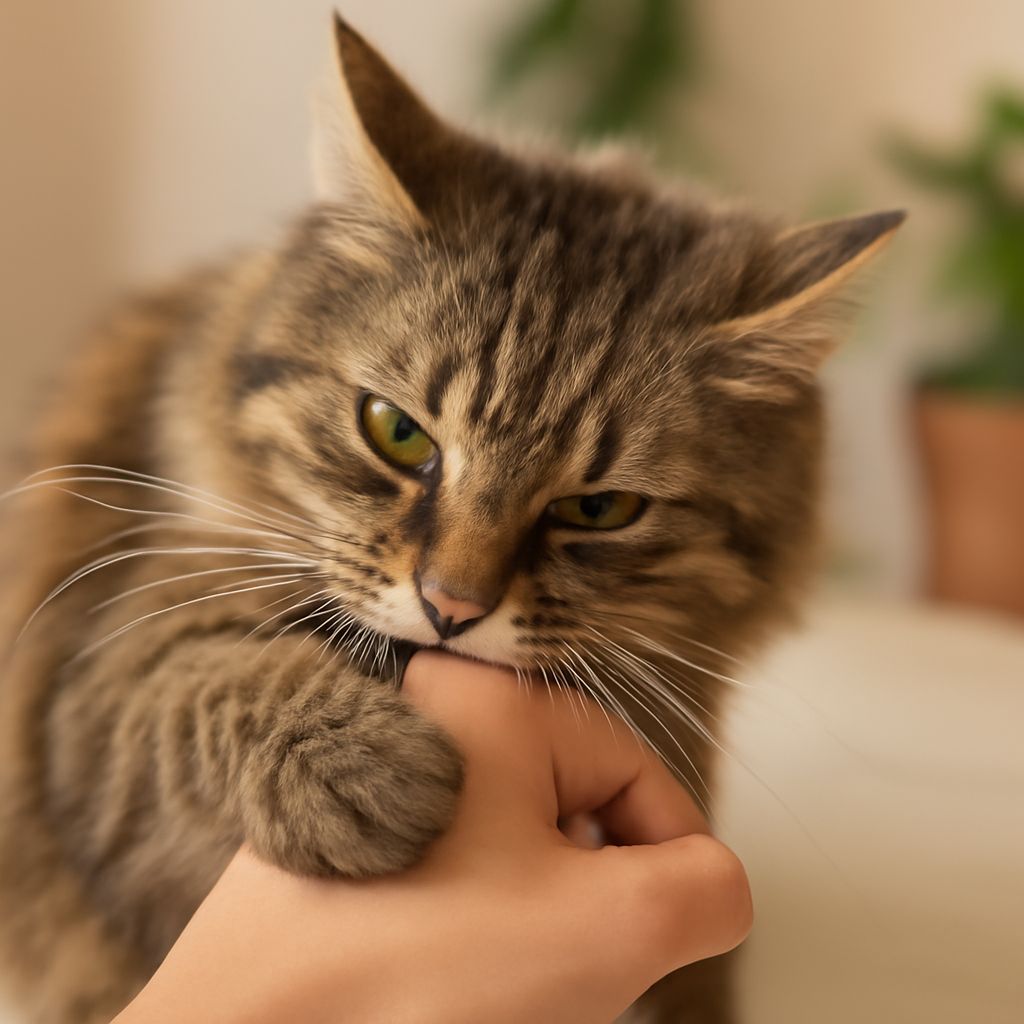
Why Is My Cat Biting Me? Causes and Solutions
You’re sitting on the couch petting your cat, everything seems fine, and then out of nowhere they turn and sink their teeth into your hand. Not a gentle nibble, a real bite. You pull your hand back confused and a little stung, wondering what just happened. Why is my cat biting me when I was literally just being affectionate? This is one of the most common questions cat owners search, and the answer almost always comes down to something the cat was communicating before the bite that went unnoticed.
A biting cat isn’t being random or malicious. When a cat bites me, or when my cat bites me in any context, there’s a reason behind it. Learning why does my cat bite involves paying attention to the moments before the bite rather than the bite itself. Most cat biting is preventable once you understand the signals.
The Most Common Reasons Cats Bite
Cat biting falls into several distinct categories. Identifying which one applies to your cat changes the solution entirely.
Overstimulation Biting
This is the single most common type, and it’s exactly what happens in the petting scenario above. Cats have a tolerance threshold for physical contact. Once that threshold is crossed, they bite to say stop. The threshold varies enormously between individuals; some cats tolerate extended petting sessions, others reach their limit after thirty seconds on the belly.
Watch for the pre-bite signals: tail twitching or lashing, skin rippling along the back, ears flattening or rotating backward, whiskers pulling back, and a sudden stillness or tenseness in the body. These all precede most overstimulation bites by several seconds. When you see them, stop petting and give the cat space.
Play Biting
Kittens bite during play because biting is part of how cats hunt and practice predatory skills. A biting cat who pounces on your feet or ambushes your moving hand is playing, not attacking. The bite is still real, but the intent is different. Play biting in adult cats often happens when the cat hasn’t had enough interactive play and is redirecting hunting energy toward humans.
The fix is straightforward: redirect play toward appropriate toys. Wand toys and feather teasers let cats fully express hunting behavior without your hands being the target. Daily play sessions of 10 to 15 minutes significantly reduce play biting in most cats.
Fear and Defensive Biting
When a cat feels trapped, threatened, or unable to escape a situation, biting is a last-resort defense. This type of biting happens when you pick up a cat who doesn’t want to be picked up, when a cat is cornered by a child or another animal, or when a cat is in an unfamiliar environment with no hiding spots. The bite is a communication breakdown after warning signals like hissing and swatting were ignored or not noticed.
Pain-Related Biting
A cat who has never bitten before and suddenly starts biting when touched in specific areas may be in pain. Arthritis, dental pain, skin conditions, and injuries all make cats more reactive to touch. If why does my cat bite is a new question for an older cat or a cat with a previously calm temperament, a veterinary exam is the first step.
How to Respond When a Cat Bites You
Never pull your hand away sharply when a biting cat latches on. This triggers the cat’s grip reflex and usually results in a deeper bite. Instead, push your hand gently toward the cat’s mouth momentarily; this counterintuitive motion causes most cats to release. Then withdraw calmly and without drama.
Do not yell, hit, or spray the cat with water. These responses increase fear and arousal, making future biting more likely rather than less. Calm disengagement tells the cat their signal worked and removes the trigger.
Building a Less Bitey Relationship
Track when bites happen and look for patterns: time of day, what you were doing, where you were touching the cat. Most biting cats have consistent triggers. Once you know the triggers, you can work around them while gradually desensitizing through positive reinforcement, pairing the trigger with high-value treats to build a new association.
Next steps: Start observing your cat’s pre-bite body language during your next petting session and stop before they reach threshold. Add a 10-minute daily interactive play session to reduce play-biting specifically. If biting is new behavior in a previously calm cat, schedule a vet check to rule out pain as the driver.