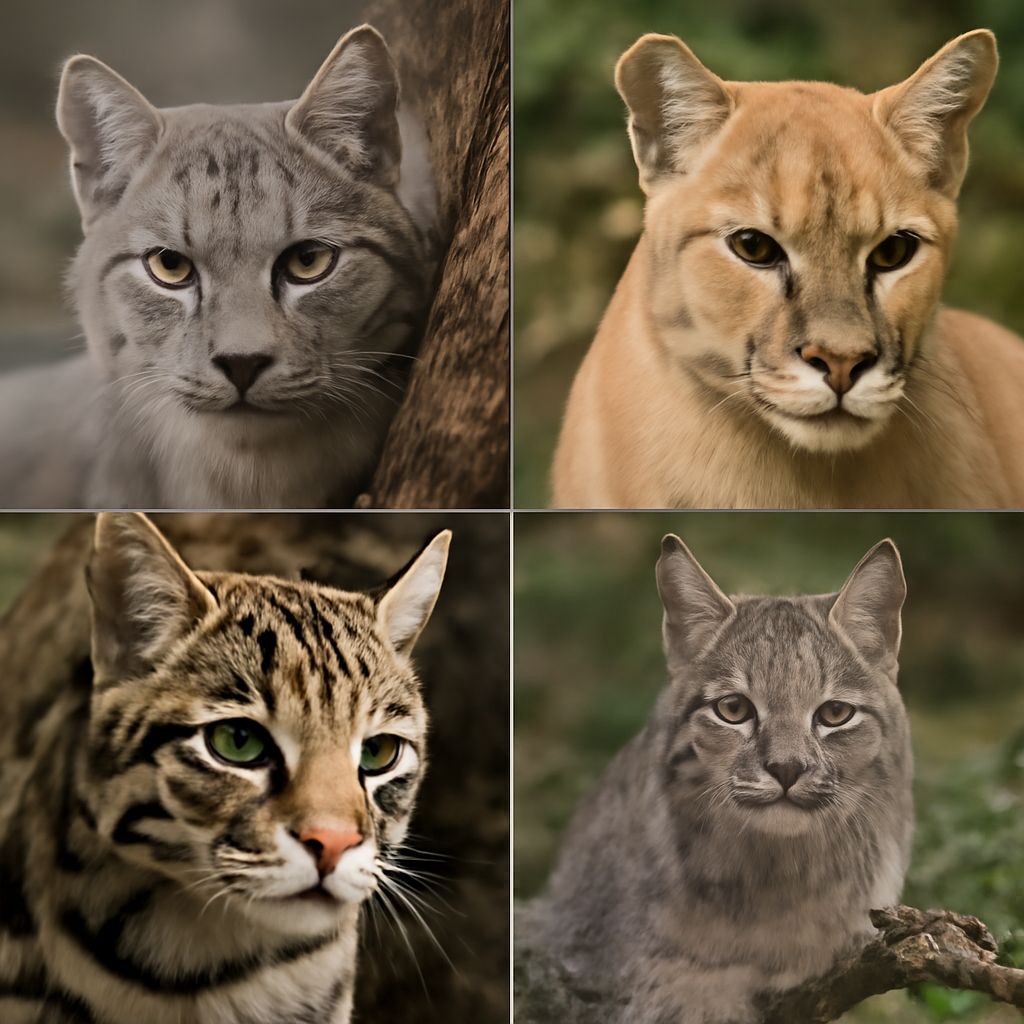
types of cats wild: A Guide to Wild Cat Species
You’re watching a nature documentary and realize you can only name three or four wild cats off the top of your head. Lions, tigers, leopards, and maybe cheetahs. But there are dozens more, and many are fascinating in ways that don’t make prime time. If you’ve been curious about types of cats wild and what separates them from each other, this guide covers the main groups and some of the lesser-known species worth knowing.
Types of wild cat range from the massive Siberian tiger to the sand cat, a desert species small enough to fit in a shoebox. The wild cat types split broadly into large cats and small cats, though the biological line between those groups is more nuanced than size alone. If you want a proper list of wild cats organized by range and characteristics, or you’re curious about breeds of wild cats that have influenced domestic cat genetics, this is the right starting point.
The Major Wild Cat Groups
Big Cats of the Panthera Genus
The Panthera genus includes lions, tigers, leopards, jaguars, and snow leopards. These are the species capable of roaring, a trait made possible by a flexible hyoid bone structure. Tigers are the largest, with Amur tigers reaching over 600 pounds. Jaguars are the only Panthera species native to the Americas. Snow leopards inhabit high-altitude Central Asian ranges and are notoriously difficult to observe in the wild. These types of wild cat are what most people picture when they hear the phrase big cats.
The Cheetah
Cheetahs belong to their own genus, Acinonyx, and are the only cat that cannot fully retract its claws. This gives them traction during high-speed pursuit but makes them less effective climbers than most other wild cat types. Cheetahs are the fastest land animals on earth, capable of reaching 70 mph in short bursts. They hunt by sight and during daylight hours, unlike most other wild species that rely on ambush tactics at dawn or dusk.
Medium Wild Cats
This group includes pumas (also called cougars or mountain lions), ocelots, servals, and caracals. Pumas have the widest geographic range of any wild cat in the Western Hemisphere, from Canada to Patagonia. Servals are long-legged African cats with disproportionately large ears that help them locate rodents under dense grass. Caracals are powerfully built and famous for their ability to leap and catch birds mid-flight.
Small Wild Cats
The list of wild cats includes over 30 small species that rarely appear in documentaries. The fishing cat hunts in wetlands and swims readily. The sand cat survives in desert conditions where surface temperatures exceed 160 degrees Fahrenheit by retreating underground during the day. The Pallas’s cat, native to Central Asia, has the densest fur of any wild felid, adapted for extreme cold. These breeds of wild cats are the least studied and most at risk from habitat loss.
Wild Cats and Domestic Cat Genetics
All domestic cats descend from the African wildcat, Felis lybica, which was domesticated in the Near East roughly 10,000 years ago. Some modern domestic breeds carry genetic contributions from hybridization with other wild species. The Bengal breed was developed through crosses with the Asian leopard cat. The Savannah cat has serval ancestry. These are deliberate breeding programs, not naturally occurring hybrids, and each generation further removed from the wild ancestor is more temperamentally similar to a standard domestic cat.
Pro Tips Recap
If you’re building deeper knowledge of wild cat types, start with the Panthera species and work outward to medium and small cats, since the smaller species receive far less coverage but are equally interesting. Conservation status matters too: many small wild cats face greater extinction risk than well-known large species because they receive less research funding and public attention.