
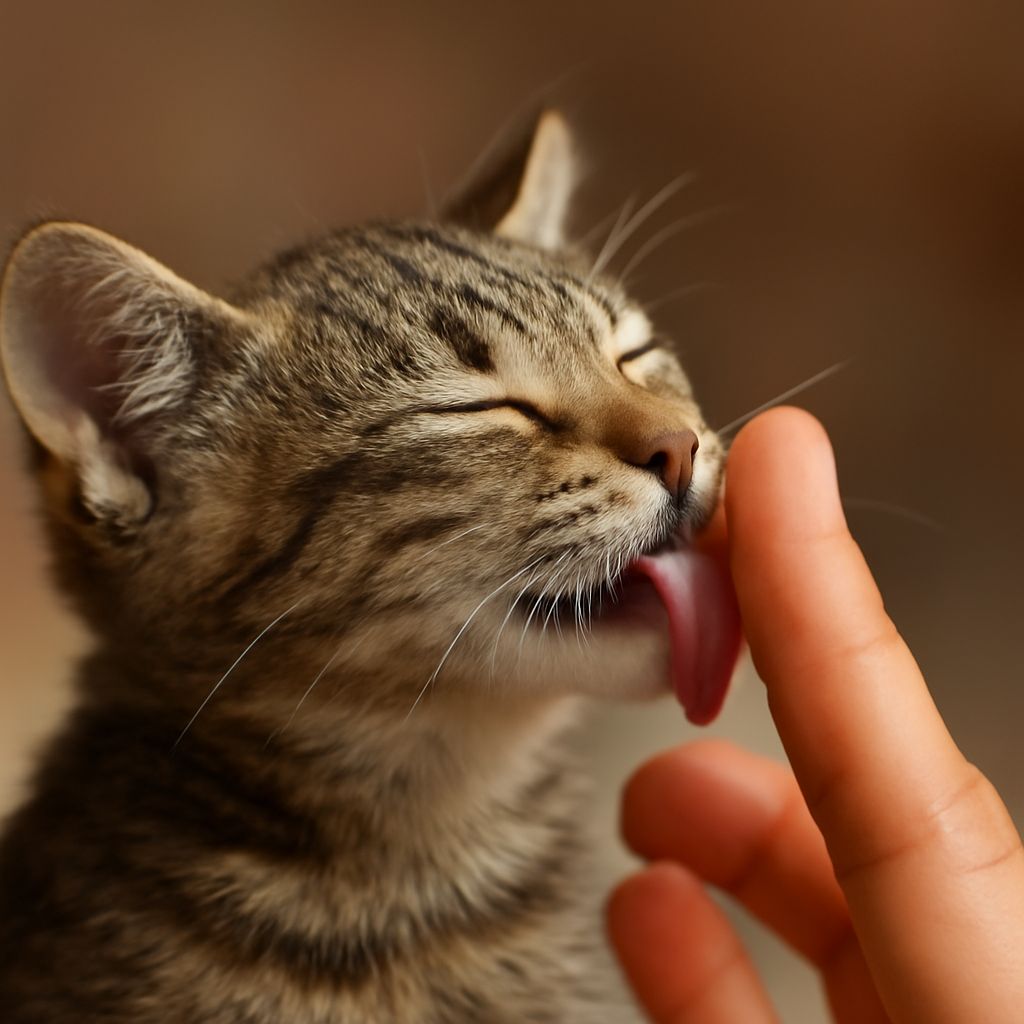
You are sitting on the couch when your cat climbs into your lap and starts grooming your hand with that rough, sandpaper tongue. You wonder: what does it mean if a cat licks you? Is this affection, a habit, or something else? When your cat licks you, it is drawing on deeply instinctive behavior rooted in how cats communicate and bond with each other. Cats licking family members — human or feline — is generally a positive sign that your cat feels safe and connected with you. The behavior of cats licking people closely mirrors what cats do when they groom kittens or trusted companions.
However, context matters. There is a meaningful difference between casual affectionate licking and cat excessive licking, which can sometimes signal stress, anxiety, or a health issue worth addressing. This guide covers both, so you can read your cat accurately and take action when needed.
Why Cats Lick People: Social Bonding and Communication
Understanding what does it mean if a cat licks you starts with feline social behavior. Mother cats lick their kittens constantly in the early weeks — to clean them, stimulate circulation, and reinforce the bond between them. Adult cats who live together continue this behavior as a form of social grooming called allogrooming, typically focusing on areas that are hard to reach alone, like the top of the head and the neck.
When your cat licks you, they are extending this same behavior to you. It communicates: you belong to my social group. Your cat is treating you the way they would treat a trusted companion. Cats that lick their owners tend to be more bonded and social cats overall, though even reserved cats occasionally express affection this way.
Cats licking skin also has a practical angle — your skin carries salts and trace scents from the food you have handled, lotions, or simply your natural body chemistry. The licking may partially be your cat investigating these interesting scents rather than purely expressing affection. Both motivations can coexist.
When your cat licks you in specific contexts — after you have been away, when you are sitting quietly together, or when you have been handling another animal — it often reflects a desire to reclaim your scent and reinforce your shared bond. It is the feline version of a reassuring touch.
When Your Cat Licks You Excessively: What to Watch For
Cat excessive licking directed at you — long sessions that feel compulsive rather than affectionate, or licking that happens even when you redirect away repeatedly — can reflect something different. If your cat licks you insistently for extended periods, especially while seeming restless or anxious, this pattern is worth paying attention to.
Excessive licking in cats directed at themselves (self-grooming to the point of hair loss or skin irritation) is a well-documented sign of stress, anxiety, or medical conditions like skin allergies or hyperthyroidism. When this behavior is directed outward at you instead of inward at themselves, it can still signal that your cat is in an anxious or overstimulated state and is using the licking as a self-soothing mechanism.
Changes in the pattern of licking are the key indicator. If your cat has always been a mild licker and remains that way, the behavior is almost certainly normal social bonding. If the frequency or intensity escalates suddenly, or if it is accompanied by other behavior changes like increased vocalization, hiding, or changes in eating habits, it is worth noting as a possible sign of stress or an underlying health concern.
Excessive Licking in Cats: Health and Stress Signals
Excessive licking in cats — whether self-directed or outward-directed — can be triggered by a range of factors. Environmental stressors include changes in routine, new pets or people in the household, construction noise, or moving homes. Medical causes include skin conditions, pain, gastrointestinal issues, and hormonal imbalances. A vet can rule out physical causes through examination and simple diagnostics.
If your cat licks you compulsively and also shows signs of self-directed excessive licking — bald patches on the belly, inner legs, or flanks — a vet visit is the appropriate next step. Behavioral modification, environmental enrichment, and in some cases anti-anxiety support can address compulsive licking effectively when a medical cause has been ruled out.
Next Steps for Understanding Your Cat’s Licking
For most cat owners, cats licking behavior is straightforward: your cat loves you and is expressing it the way cats naturally do. Enjoy the rough-tongued affection. If you find the sensation uncomfortable, gently redirect your cat with a toy or offer your hand for sniffing rather than pushing them away, which can feel like rejection. If you notice a shift toward cat excessive licking or compulsive patterns, track the behavior for a week and discuss it with your vet — early attention to behavioral changes produces the best outcomes.