You are planning a network installation and someone on a forum mentioned cat 6e as the go-to choice, but when you search for it the results seem inconsistent. The cat 5 color code you memorized years ago for making cat 5 cable still works — but now you are wondering where cat 6e fits relative to cat 6 vs cat 6e options, and how cat 6a vs cat 6e compares when shopping for cables. Ethernet cable naming conventions are confusing even for experienced network installers, partly because some designations are standardized and some are not.
This guide clarifies what each cable type actually offers, where the marketing muddies the water, and how the practical choice between them shakes out for home and small business installations.
What Is Cat 6e and Does It Exist
Cat 6e is not a formally standardized cable category recognized by IEEE (Institute of Electrical and Electronics Engineers) or TIA (Telecommunications Industry Association), the two main standards bodies that define ethernet cable specifications. Cat 5, Cat 5e, Cat 6, Cat 6a, and Cat 7 are all formally defined standards. Cat 6e appears primarily as a marketing label used by some cable manufacturers to position products as enhanced Cat 6 without the full certification of Cat 6a.
In practice, when you see a cable labeled cat 6e, you should look at its actual technical specifications rather than the category label. Some cat 6e cables perform close to Cat 6a specs; others perform at Cat 6 levels with a premium price tag. The only way to know what you are buying is to review the crosstalk ratings, bandwidth rating (MHz), and any third-party testing certifications on the specific product.
Why the Naming Confusion Exists
The jump from Cat 5 to Cat 5e was a legitimate standards revision that improved crosstalk specifications for 1000BASE-T (Gigabit) networks. Manufacturers of enhanced Cat 6 products applied the same pattern informally by using “e” to signal enhancement without undergoing the full standards certification process. This has created genuine marketplace confusion, especially for buyers unfamiliar with the standards landscape.
Cat 6 vs Cat 6e vs Cat 6a Explained
Cat 6 is a formally standardized cable supporting 10GBASE-T speeds up to 55 meters and Gigabit ethernet up to 100 meters. It specifies performance up to 250 MHz. Cat 6 is the standard workhorse for modern structured cabling installations and performs well for the vast majority of home and small business needs.
Cat 6a (augmented Cat 6) is the formal upgrade. It supports 10GBASE-T up to 100 meters and specifies performance up to 500 MHz. The “a” is a real, IEEE-defined designation. Cat 6a cables are typically thicker, stiffer, and more expensive than Cat 6. They are the right choice when you need reliable 10 Gigabit performance over longer runs or in environments with higher electromagnetic interference.
Cat 6 vs cat 6e comparison: if the cat 6e product you are evaluating meets Cat 6a specifications and is priced competitively, it may be a reasonable purchase. If it matches Cat 6 specs at a Cat 6a price, it offers no advantage over standard Cat 6. Cat 6a vs cat 6e: official Cat 6a cables from reputable manufacturers with TIA certification are a safer and more predictable choice when 10G performance over longer distances is required.
For Most Home Installations
Cat 6 is typically sufficient for home networks running Gigabit ethernet — which is the standard for most home internet connections, NAS devices, and home media servers. Unless you are wiring a dedicated 10G backbone or have specific high-bandwidth requirements, the cost difference of Cat 6a or the ambiguity of cat 6e products rarely justifies the premium over standard Cat 6.
Cat 5 Color Code: Wiring Standards
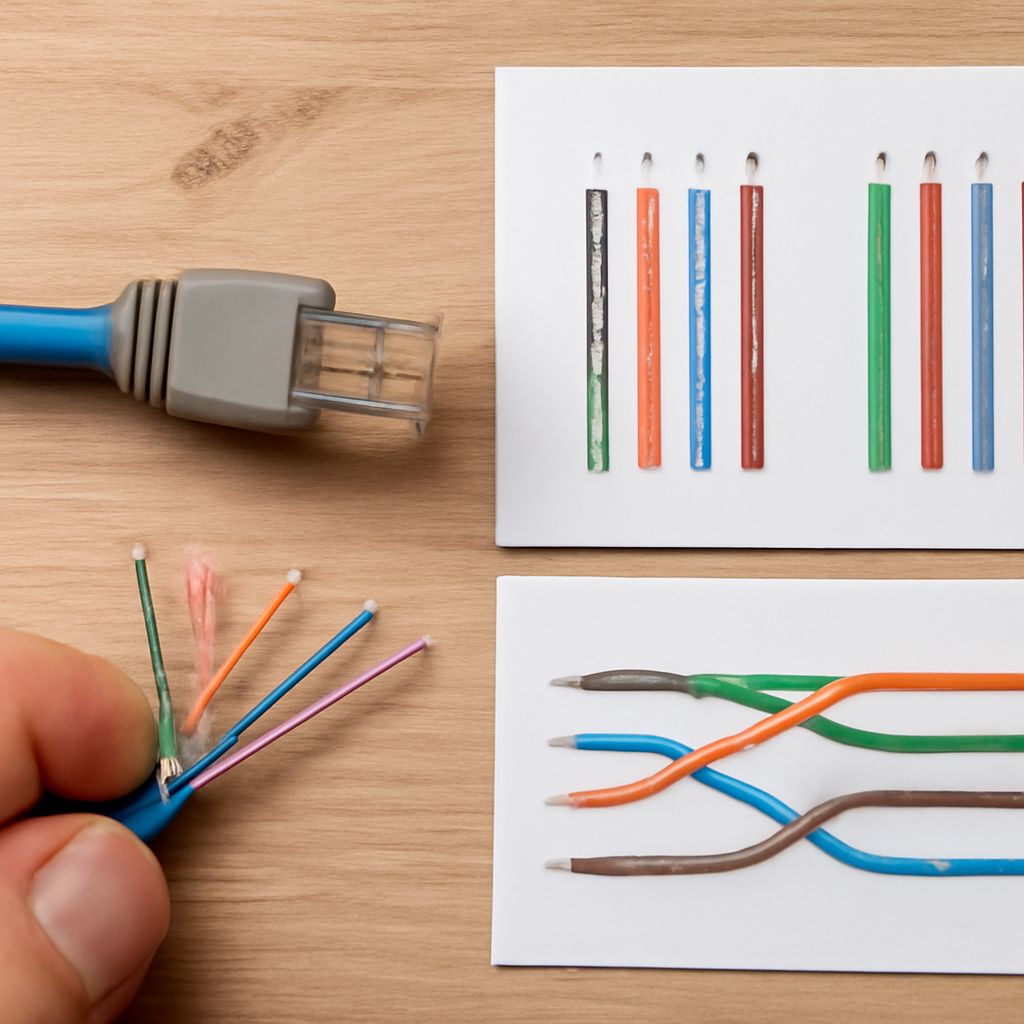
The cat 5 color code refers to the wire pair arrangement used in RJ-45 terminations. The two dominant wiring standards are T568A and T568B, defined by TIA-568. In T568B (the more common standard in the United States): pin 1 is white-orange, pin 2 is orange, pin 3 is white-green, pin 4 is blue, pin 5 is white-blue, pin 6 is green, pin 7 is white-brown, and pin 8 is brown. T568A swaps the orange and green pairs.
The cat 5 color code applies equally to Cat 5e, Cat 6, Cat 6a, and most other ethernet cable types because the wiring standard is about the connector interface, not the cable category. What matters most is consistency: use the same standard (A or B) at both ends of a straight-through cable, and opposite standards at each end of a crossover cable.
Making Cat 5 Cable: Tips and Pro Advice
Making cat 5 cable — which also applies to making Cat 5e or Cat 6 cables with the same technique — requires a crimping tool, RJ-45 connectors appropriate for your cable type (solid vs. stranded wire connectors differ), and a cable tester. Strip the outer jacket carefully without nicking the inner pairs. Untwist the pairs only as far as needed to straighten them for insertion — maintaining twist as close to the connector as possible reduces crosstalk. Arrange wires in T568B or T568A order, trim to even length, insert into the connector with all wires seated fully to the front, and crimp firmly. Test both ends with a cable tester before routing the cable.
Pro tips recap: For most installations, standard Cat 6 with T568B termination is the right choice. Avoid ambiguous cat 6e labels and instead verify actual specs. When making your own patch cables, use a quality crimping tool and always test before finalizing the run. Consistent wiring standards across an installation saves significant troubleshooting time later.