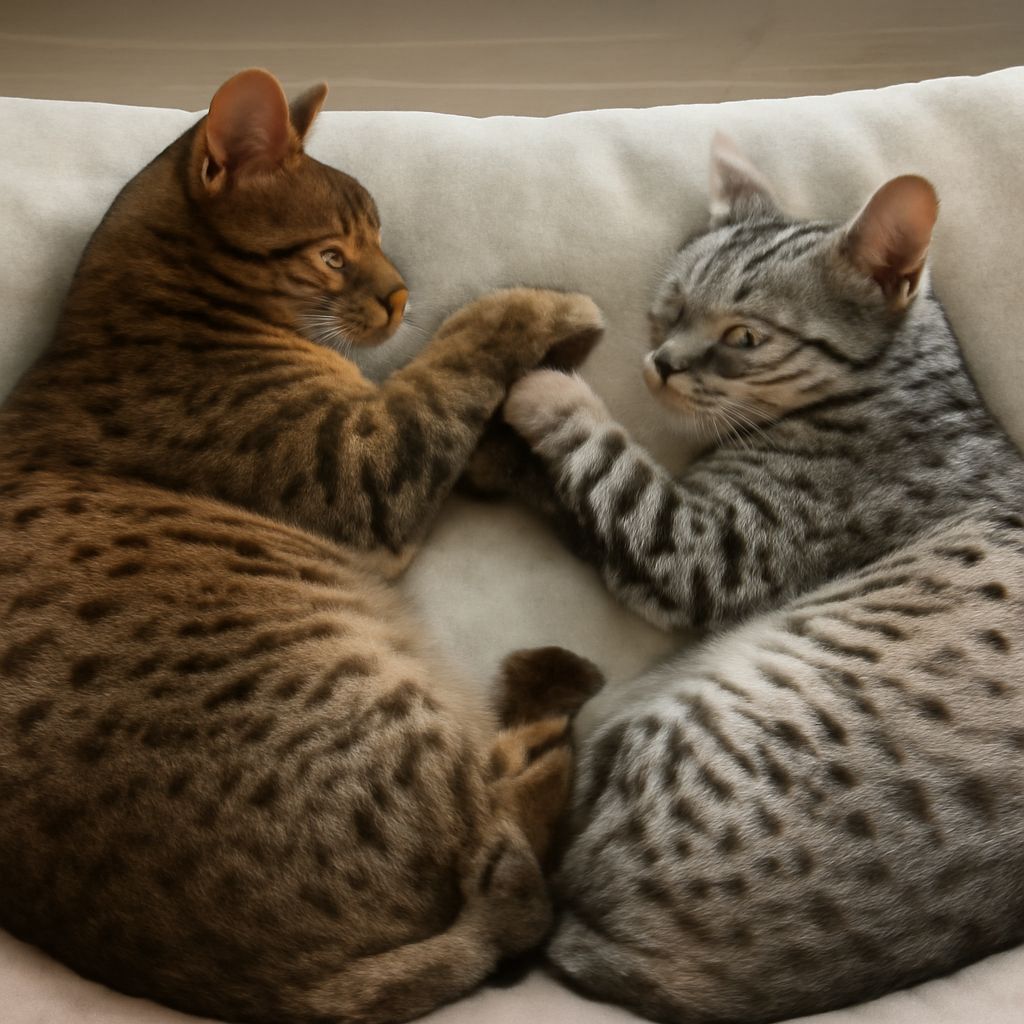
You’re at the shelter and you see a cat with a coat that doesn’t fit neatly into any category you know. Part grey, part white, with subtle markings you can’t quite name. Or maybe you’ve been trying to describe your own cat online and someone asks “is that a ticked tabby cat?” and you realize you don’t actually know. Cat coat genetics produce a remarkable variety of patterns, and learning the terminology helps you appreciate just how distinctive each one is.
This guide covers the most common patterns you’ll encounter, including the white and grey cat combination, the ticked tabby cat, and the spotted tabby cat. We’ll also look at cats on the warmer end of the spectrum — the dark orange cat and the white cat with orange spots — so you get a complete picture of how these patterns develop and what makes each one different.
White and Grey Cat Patterns
Bicolor Cats
A white and grey cat is most often a bicolor, meaning the coat has two distinct colors distributed across the body. The amount of white versus grey varies widely. A cat with a mostly grey coat and white paws and chest is still a bicolor, just as a mostly white cat with grey patches is. The gene responsible for white in bicolor cats is the white spotting gene (S locus), which suppresses pigment in certain areas of the coat.
Grey Tabby with White
Some cats look like grey and white animals at a glance but are actually grey tabbies with white areas. Under good light, you’ll see faint tabby striping or ticking in the grey sections. This combination is extremely common in domestic cats and goes by several informal names including “silver tabby with white” or just “grey and white tabby.”
Tabby Patterns Up Close
Ticked Tabby Cat
The ticked tabby cat has a coat where individual hairs carry multiple bands of color — typically dark at the tip and lighter toward the base. From a distance, the coat looks even or slightly shimmery without visible stripes or spots. Abyssinians are the classic example, but ticking occurs across many mixed-breed cats. Up close, you can usually find faint striping on the legs and face even in heavily ticked individuals.
Spotted Tabby Cat The spotted tabby cat has round or oval spots distributed across the body rather than continuous stripes. These spots can be bold and dark, like those on a Bengal, or small and faint on a domestic shorthair. The Bengal breed has been specifically developed for large, high-contrast spots that resemble a wild leopard cat. Spotted tabbies are genetically a modified mackerel tabby — the stripes are broken into spots by modifier genes.
Orange Cats: Dark and Spotted Varieties
Dark Orange Cat
A dark orange cat, sometimes called a deep or rich red tabby, has a coat that sits at the more saturated end of the orange spectrum. The orange color in cats comes from pheomelanin, the same pigment that produces red hair in humans. The depth of color — whether a cat is a pale cream or a dark orange — depends on how much of this pigment is produced and how densely it’s distributed in each hair shaft.
White Cat with Orange Spots
A white cat with orange spots is a bicolor cat where the pigmented areas happen to be orange rather than black or grey. These cats are often called “orange and white” bicolors. In some cases, the orange patches show tabby patterning within them — so a white cat with orange spots might also technically be a spotted tabby in the orange sections. Van-patterned cats, which have color only on the head and tail, are an extreme version of this bicolor distribution.
Next Steps
If you’re trying to identify your cat’s coat pattern, start by looking at individual hair strands with good lighting — ticking, tipping, and banding are visible at that level. Note where any white areas begin and end, and check whether the colored sections show stripes, spots, or even patterning. Online cat genetics communities are surprisingly helpful for hard-to-classify coats, and many shelter intake forms now record pattern along with color for better recordkeeping.