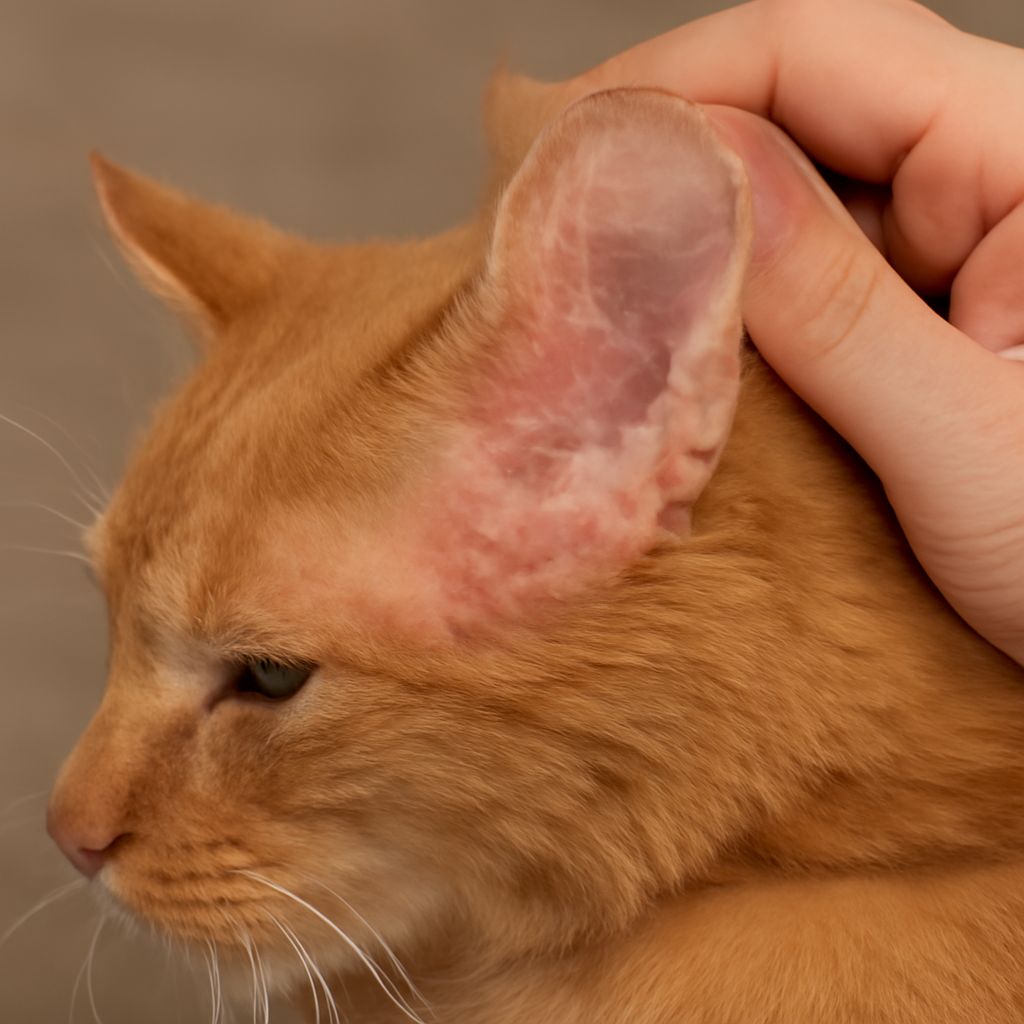
You’ve been noticing that your cat has been scratching more than usual — not just a quick scratch, but persistent, focused scratching at the same spots on their neck and behind their ears. You check the area and see red, irritated skin with some hair thinning and what might be small scabs. Something is clearly wrong, but you’re not sure if you’re looking at a cat skin infection, an allergy, a parasite, or something else entirely.
Cat skin issues are among the most common reasons owners bring their cats to the vet, and the range of possible causes is wide. Skin infections in cats can be bacterial, fungal, or parasitic; cat skin issues that look the same on the surface can have completely different underlying causes. Skin issues in cats also tend to overlap with allergic and hormonal conditions. Understanding the broad categories — and knowing when cats skin conditions need a vet versus home management — is the foundation for getting your cat comfortable again.
Common Types of Cat Skin Infections
Bacterial Skin Infections Bacterial skin infections in cats are usually secondary — meaning they develop on top of skin that was already compromised by scratching, an allergic reaction, or a wound. The most common bacteria involved are Staphylococcus species. Signs include crusting, oozing, hair loss in patches, and a slightly sweet or pungent smell to the affected area. The lesions are often found where the cat can reach to scratch: neck, face, and the base of the tail.
Treatment typically involves antibiotics (oral or topical), clipping the affected area for better air circulation, and addressing the underlying trigger that damaged the skin in the first place. Treating the infection without fixing the source — allergies, parasites, or obsessive grooming from stress — leads to recurrence.
Fungal Infections: Ringworm
Ringworm is the most common fungal cat skin infection and it’s actually not a worm at all — it’s Microsporum canis, a dermatophyte fungus. Classic ringworm in cats presents as circular patches of hair loss with scaling at the border, often on the face, ears, and forelimbs. Some cats carry ringworm without obvious lesions (subclinical carriers), which is why whole-household exposure is important to consider.
Ringworm is zoonotic — it can transfer from cats to humans. Children, elderly people, and immunocompromised individuals are most susceptible. Treatment in cats involves antifungal shampoo, topical antifungal cream for localized lesions, and oral antifungal medication for more extensive cases. Environmental decontamination (vacuuming, washing bedding, treating surfaces) is necessary to prevent reinfection.
Parasitic Skin Issues
Fleas are the most common parasitic cause of cat skin issues, and flea allergy dermatitis (FAD) is the most common skin condition in cats overall. Cats with FAD react severely to flea saliva — even a single flea bite causes intense itching, hair loss along the back and base of the tail, and secondary skin damage from scratching. The cat may have no visible fleas (they groom them off) while showing severe skin symptoms.
Mites cause two main cats skin conditions: ear mites (Otodectes) affect the ears primarily, while Cheyletiella mites cause “walking dandruff” — heavy scaling visible across the back. Both are highly contagious between cats. Demodex mites are less common in cats than in dogs but do occur, particularly in immunocompromised animals.
Allergic and Other Non-Infectious Skin Issues in Cats
Environmental and Food Allergies
Skin issues in cats from allergies present similarly to infections — itching, hair loss, skin damage — but without an infectious agent driving them. Food allergies in cats most commonly involve proteins: chicken, beef, fish, and dairy are frequent culprits. Environmental allergies (atopy) involve reactions to dust mites, mold, and pollen. Distinguishing between the two requires either a dietary elimination trial (for food allergy) or allergy testing (for environmental).
Psychogenic Alopecia
Some cats develop symmetrical hair loss along the belly and inner thighs from stress-related over-grooming rather than any skin disease. The skin itself is healthy; the cat is simply licking themselves bald. This is more common in anxious or indoor cats, and addressing it requires identifying and reducing stressors rather than treating a cat skin infection that isn’t there.
Diagnosing and Treating Cat Skin Conditions
Your vet will use skin scrapes, fungal cultures (Wood’s lamp or DTM culture for ringworm), cytology of any exudate, and sometimes biopsy to identify what’s causing your cat’s skin issues. This matters because treating a bacterial infection with antifungal medication — or vice versa — won’t work and wastes time while your cat continues to suffer.
For home care between vet visits: keep affected areas clean and dry, prevent your cat from further traumatizing the skin with a cone if necessary, and avoid applying human skincare products or over-the-counter antifungal creams without vet guidance — some ingredients are toxic to cats when groomed off.
Bottom line: Cat skin infections and skin issues are common but rarely straightforward — the cause matters as much as the symptoms for choosing the right treatment. See a vet for any skin problem that’s worsening, affecting a large area, or not improving within a week of conservative care. Early diagnosis saves your cat discomfort and prevents secondary complications from untreated infections.