
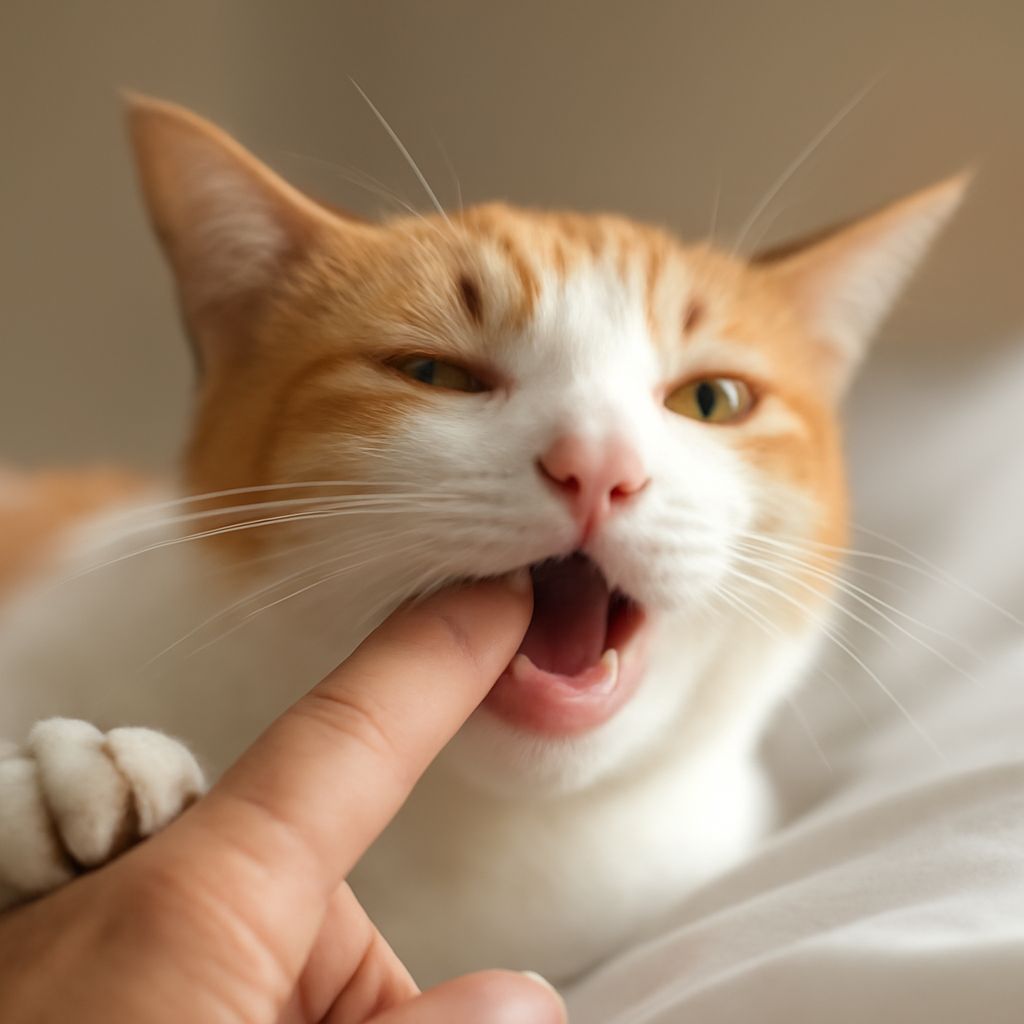
You’re petting your cat — they’re purring, completely relaxed, leaning into your hand — and then without warning, they turn and give your hand a soft, controlled bite. Not hard enough to break skin, not aggressive. Just a firm little nip. You pull back, confused. They look at you without any apparent guilt. Why does my cat bite me gently? What just happened?
This is one of the most common behavioral questions cat owners ask, and for good reason. The behavior is confusing because it happens in situations that seem entirely positive. Why does my cat gently bite me when I’m petting them and everything seems fine? Why do cats bite gently during play or affectionate moments? Why does my cat bite me softly on the hand but never on the face? And what does it mean when a cat gently bites repeatedly versus once? Let’s break it down.
The Main Reasons Cats Give Soft Bites
Love Bites: Affection in Cat Language The most commonly cited explanation for gentle biting is affection — what’s often called a “love bite” or “morsure d’amour” in veterinary behavior literature. Cats use their mouths in social interactions with other cats: grooming bites, play bites, and gentle mouthing are all normal parts of cat-to-cat communication. When a cat gently bites a human, they may be extending that same social behavior.
These are typically light, brief, and accompanied by other affiliative signals: purring, slow blinking, relaxed body posture. If your cat gently bites your hand and then immediately resumes purring or grooming, this is almost certainly in the love bite category. Why do cats bite gently in this way? Likely because it’s how they would interact with a bonded companion.
Petting-Induced Overstimulation
Many gentle bites happen not out of affection but out of sensory overload. Cats have a threshold for physical stimulation that varies by individual and by location on the body — some cats tolerate extensive belly contact; others find it intolerable after a few seconds. When that threshold is crossed, the cat’s response is often a soft bite — a warning before escalating to a harder bite or scratch.
Why does my cat bite me softly in the middle of what seems like enjoyable petting? Watch for the pre-bite signals: tail flicking or thumping, skin rippling along the back, ears rotating slightly back, a sudden shift in muscle tension. These are the cat’s way of saying “enough” before they escalate. If you stop petting when you see these signals, the bite often doesn’t happen at all.
Play Behavior and Hunting Rehearsal
Cats rehearse hunting behaviors constantly — through play with toys, through ambush games, and sometimes through interactions with your hands. A cat that gently bites your hand, holds it briefly, then releases is running through a predatory sequence. The bite is controlled because they’re not hunting in earnest; it’s the same behavior pattern with the intensity dialed down.
This type of gentle biting is more common in cats that haven’t been taught from kittenhood that hands are not toys. If you played rough games with your cat when they were a kitten — allowing them to bite and scratch hands during play — the adult cat is continuing a learned pattern. It’s not aggression; it’s a miscalibrated play style.
Communication and Attention-Seeking Sometimes a cat gently bites because it works. They bite, you react, attention happens. Cats learn this quickly. A soft bite that gets you to look at them, talk to them, or move toward their food bowl has been positively reinforced. Why does my cat bite me gently when I’m on my phone and ignoring them? You already know the answer: because it gets results.
How to Respond to Gentle Biting
What Not to Do
Don’t pull away sharply — this can trigger the predatory instinct and result in a harder bite. Don’t push your hand toward the cat’s mouth as a counter-pressure response; this is confusing and often escalates the bite. Don’t punish the cat physically — this creates anxiety and can make the behavior worse.
Redirecting the Behavior
For overstimulation bites, the best response is simply to stop petting when you see the pre-bite signals. Over time, your cat learns that certain signals end the petting session, which gives them a way to communicate that doesn’t involve biting. For play bites, redirect to a toy immediately when a bite happens — the play instinct is still active; you’re just channeling it appropriately.
For attention-seeking bites, the strategy is to not reward the bite with attention. Look away, stand up, leave the room. This is difficult to maintain consistently, but it’s the only thing that actually changes the behavior over time.
Next steps: Observe when your cat’s gentle biting happens — during petting, during play, or in quiet moments when you’re not paying attention to them. Each pattern points to a different cause with a different solution. Keep a mental note of the pre-bite body language for a week, and you’ll quickly identify whether you’re dealing with overstimulation, play behavior, or something your cat has learned gets them what they want.