
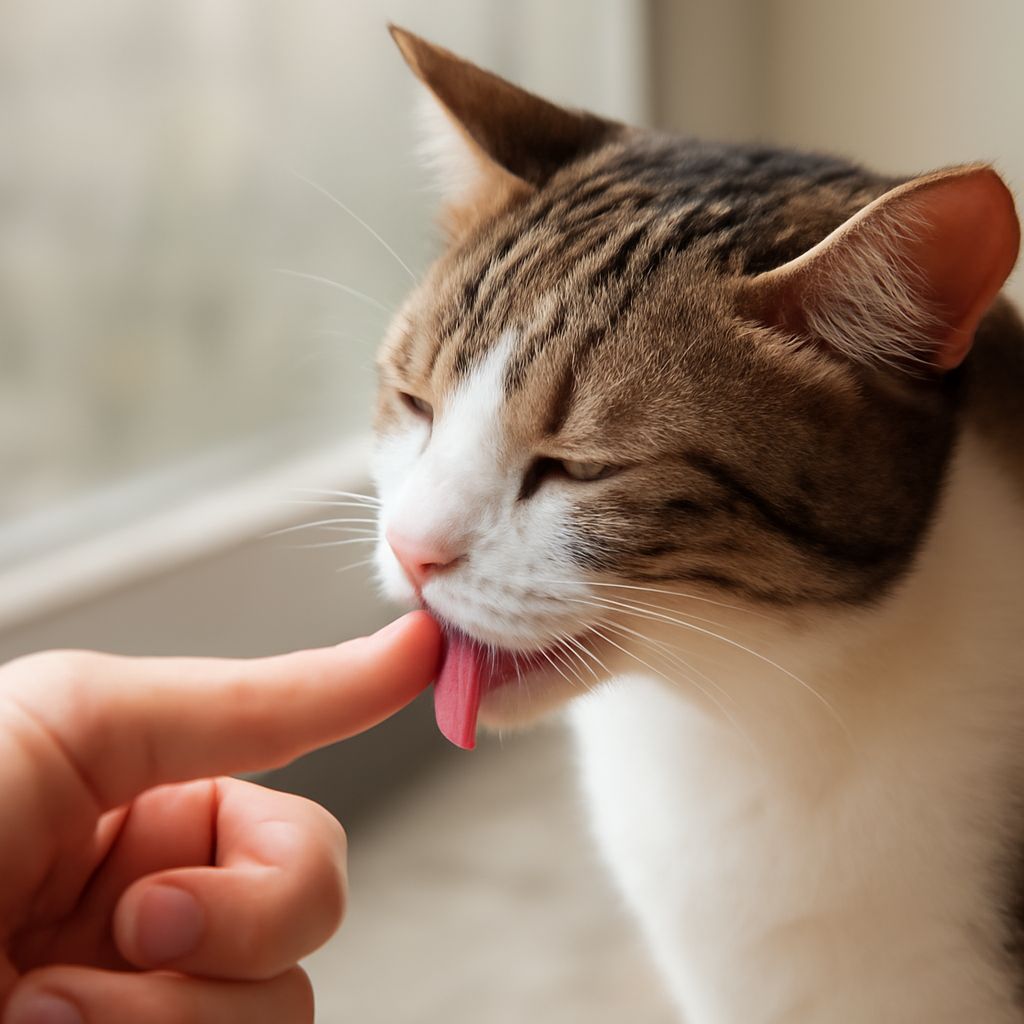
You’re sitting on the couch watching TV and your cat climbs up, settles next to your arm, and starts methodically licking your hand. It’s oddly satisfying — that rough little tongue working away — but you’re curious: what does it mean when a cat licks you? Is this affection? Grooming? Something else entirely? You’ve wondered this before but never looked it up. Today’s the day.
Why does cat lick me, you think. And the answer is: probably several things at once. When a cat licks you, it’s drawing on behaviors that are deeply wired into how cats relate to each other. Why do cats lick me specifically rather than anyone else in the household? That preference actually tells you something useful. When cats lick you, they’re communicating — and the message is almost always positive.
The Main Reasons Cats Lick People
Social Grooming and Bonding Cats groom each other — a behavior called allogrooming — as a way to reinforce social bonds. When a cat licks you, they’re extending that same behavior to a human they trust. Cats groom the individuals in their social group: littermates, bonded housemates, and people they feel genuinely attached to. Being on the receiving end of this means your cat considers you part of their group. It’s a compliment, even when the sandpaper tongue makes your skin red.
Allogrooming tends to focus on areas cats can’t easily reach themselves: the top of the head, the back of the neck. When cats lick people, they often gravitate toward hands and arms because those are the surfaces most frequently available. Some cats will try to groom your hair, which is the most direct parallel to how they groom other cats.
Marking and Scent Exchange Cats have scent glands in their cheeks, paws, and skin, and licking is one way they apply their scent to something — or exchange scents with it. A cat licking your hand is partly saying “you smell like me now,” which in cat social terms means “you’re mine” in the most affectionate sense. This is the same logic behind the head bunting and cheek rubbing cats do on furniture and people they like.
Seeking Attention or Comfort Sometimes why does cat lick me is simpler: they want something. Licking can be a bid for attention, food, or just interaction. If your cat licks you insistently and then looks at you or walks toward their bowl, you’re being asked. This is less about deep bonding and more about learned behavior — licking got a response before, so licking happens again.
Tasting Salt and Moisture Human skin has salt, residues from lotion, food, and sweat — all things cats find interesting. Some licking is genuinely just exploratory: cats investigate things with their tongues as well as their noses. If your cat licks you immediately after you’ve been cooking or applying something with an unfamiliar scent, this is probably what’s happening.
When Licking Becomes Excessive
Anxiety and Stress-Related Licking Cats that lick people obsessively — not a few passes but prolonged, persistent licking sessions that are hard to interrupt — may be dealing with anxiety or stress. Compulsive licking in cats is related to the same self-soothing mechanism behind over-grooming. A cat licking its own fur excessively can develop bald patches; a cat channeling that behavior onto a person creates an intensity of interaction that feels different from normal social grooming.
Changes in household routine, the arrival of a new pet, or a stressful move can all trigger this. If the licking has escalated noticeably and your cat seems more anxious overall — hiding more, eating less, startling easily — it’s worth a conversation with your vet.
Medical Causes
In some cases, a cat that licks people or objects compulsively has an underlying health issue: nausea, gastrointestinal discomfort, or a neurological condition. Pica — the tendency to lick or ingest non-food items — can extend to licking skin. If your cat’s licking is very recent, sudden in onset, and directed at unusual objects as well as people, a vet check rules out medical causes.
What to Do If You Don’t Want Your Cat to Lick You
Redirecting this behavior is easier than stopping it outright. When your cat starts licking, offer a toy or start a play session — both redirect the energy into something else. Standing up and walking away consistently also works; cats learn quickly that licking ends the interaction rather than sustaining it. Don’t scold or push the cat away sharply, as this can create confusion for an animal that was trying to connect.
Bitter apple spray on the skin deters most cats; some cats ignore it entirely. If the licking is genuinely disruptive, consistency in redirection is more effective than any single deterrent.
Next steps: Pay attention to when and where your cat licks you — it tells you whether you’re dealing with social grooming, attention-seeking, or stress. Normal social licking is occasional, focused on accessible skin surfaces, and easy to redirect. If the intensity or frequency has changed recently, track it for a few days and mention it to your vet at your next visit.