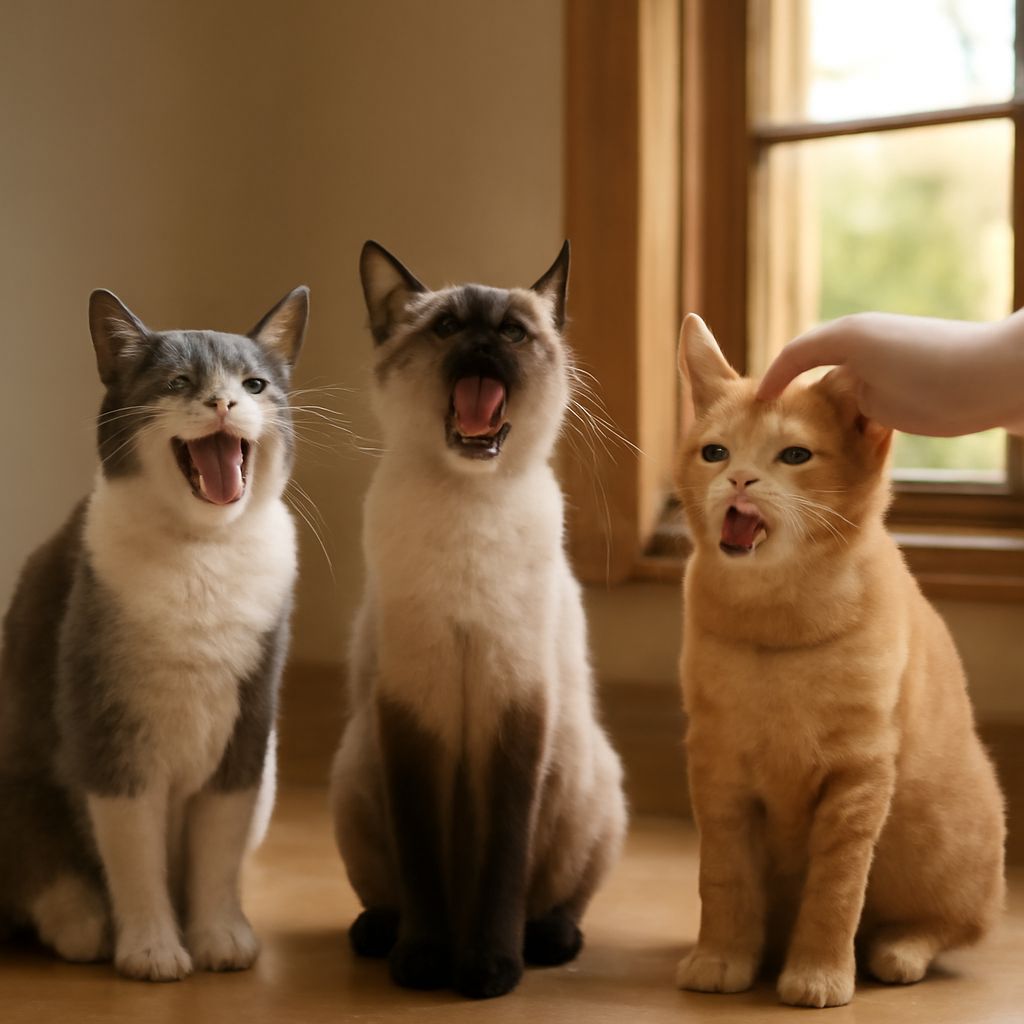
Your cat has been meowing on and off all evening and you’re not sure what they want. You’ve checked the food bowl, the water, the litter box. Everything looks fine. If you keep asking yourself why is my cat meowing without an obvious answer, the truth is that cats use meowing as a flexible tool for communicating a range of different needs and states. The sounds mean different things in different contexts.
Why do cats cry at night versus during the day often has different explanations. A cat that meows for attention at 3 a.m. is different from a cat that calls out while you’re working in the next room. And why does my cat meow in a low, insistent tone while staring at the closed bedroom door is a different communication entirely. If you also hear cats meowing at night more than during the day, there are specific reasons for that pattern. And if you have a male cat meowing persistently, there’s often a distinct reproductive drive behind it.
Why Cats Meow: The Core Reasons
Hunger and Feeding-Related Meowing
The most common reason for persistent meowing is food. Cats that eat on a schedule often start vocalizing 15 to 30 minutes before the expected mealtime. This is learned behavior: meowing has previously produced food, so the cat repeats it. Feeding a consistent schedule rather than responding to vocalizing trains this pattern. If you feed in response to meowing, you teach the cat that louder and longer gets results.
Attention and Social Meowing
Cats that want interaction often meow while making eye contact with you and then look toward where they want to go or what they want to do. This directed meowing is intentional communication. Meeting it with play or a brief petting session usually satisfies it quickly. Ignoring it sometimes works, but inconsistency teaches the cat to escalate.
Discomfort or Pain
A cat that suddenly starts meowing more than usual, especially if the tone is different from normal, may be in pain or discomfort. Older cats often increase vocalization as a sign of cognitive changes, pain from arthritis, or sensory decline. New or escalating meowing in a cat over 8 years old without an obvious behavioral trigger warrants a vet check.
Stress and Anxiety Meowing
Environmental changes, new pets, loud events, or strangers in the home can trigger vocal stress responses. A stressed cat meowing sounds different from an attention-seeking meow, often more plaintive or continuous. Address the stressor directly and provide hiding spaces and elevated perches so the cat can regulate their own stress level.
Why Cats Meow at Night
Hunger Before Morning Feeding
If the last meal was at 5 p.m. and feeding time is 7 a.m., that’s 14 hours between meals. Cats meowing at night in this context are often genuinely hungry. An automatic feeder set for 2 or 3 a.m. solves this without requiring you to get up. One small portion is enough to quiet the vocalization until the regular morning feeding.
Male Cat Meowing and Reproductive Drive
An intact male cat meowing is often related to detecting a female in heat nearby. The sound is typically loud, insistent, and very different from normal communication. Neutering eliminates this motivation in virtually all male cats. The vocalization usually reduces within a few weeks of the procedure.
Cognitive Decline in Senior Cats
Older cats with cognitive dysfunction often become confused and vocal at night, meowing in what sounds like a disoriented way. A nightlight near the litter box, consistent furniture placement, and keeping the cat in a smaller, familiar space at night helps. A vet can assess and suggest supplements or medications that reduce nighttime confusion.
Key Takeaways
Most cat meowing has a clear cause once you look at the timing, tone, and context. Rule out hunger and pain first, then consider stress and attention before deciding the behavior is just a personality trait. Consistent routines and prompt responses to genuine needs reduce most problematic meowing patterns within a few weeks.