
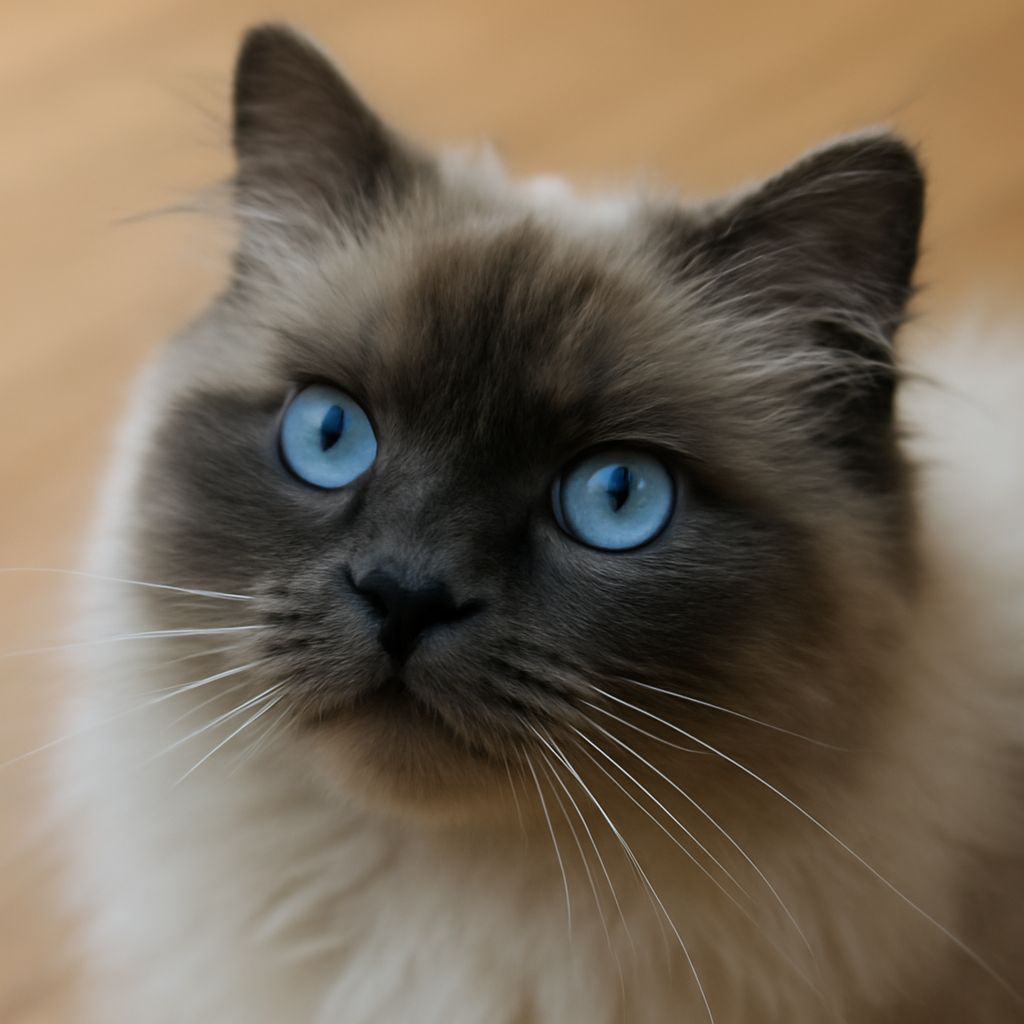
You are looking at a pale kitten with gray ears, and the adoption listing calls it a Himalayan cat with blue points. The description tells you where to start looking. It does not tell you the kitten’s family tree, and that pale coat may have more color to reveal as the kitten grows.
Blue Point Himalayan: Where to Look
A blue point himalayan cat has a light body with cooler blue-gray coloring concentrated on the face, ears, legs, feet, and tail. In cat-color language, “blue” means gray rather than the color of the sky. The face color forms a mask, while the body usually looks lighter than the extremities. Himalayan cats with this pointed pattern also have blue eyes.
Look at the whole cat in natural, indirect light. A warm lamp can make a cool gray look brownish, and shadows can turn a pale tail into a dark one. Part the long fur gently to see the color underneath the tips, but let the cat walk away if it has had enough inspection. A photograph taken near a window can help you compare markings over time.
A Himalayan cat with blue points generally shows a fairly even blue-gray in those darker areas. Contrast can be subtle in a youngster and more pronounced later. The shade of the body and the depth of the points vary, so a single picture is a poor measuring instrument for a growing cat.
What Makes a Point Tortie?
“Tortie” is short for tortoiseshell: a mixture of darker color and red or cream. On a pointed cat, look for that mixture chiefly in the mask, ears, legs, feet, and tail. The patches may be distinct or finely mingled. One ear can look different from the other, and a small warm-colored patch can be easy to miss in a thick coat.
A tortie point himalayan can have dark seal-brown points mixed with red. A blue-cream point has blue-gray mixed with cream; it belongs to the broader tortoiseshell color family, although registries may use a more specific color name. A patch of cream among the gray is the clue to look for, not a perfectly symmetrical design. The cat has no obligation to coordinate its socks.
Compare the nose and paw pads as well as the fur. Mixed pigment there can offer another clue, though these details alone do not settle every color question. A Himalayan with tortie points may show its mix more clearly in some places than others. If the apparent patch is hard to see, check again in consistent light and ask a knowledgeable breeder or the relevant registry for help with a color description.
How Kittens Change
Pointed kittens can begin life very pale, with color developing on the cooler extremities as they grow. The mask, ears, tail, and feet may become more distinct over the following months. Body shading can deepen with age, too. Temperature affects pigment development in pointed coats, which helps explain the contrast between the warmer body and cooler extremities.
Keep a few dated photos in similar light if you are curious about the change. Include the face, both sides, and tail rather than relying on one close-up. A young kitten’s final shade or the visibility of a small cream patch can be difficult to judge early. A breeder may revise a tentative color description as the coat develops.
Color tells you how the coat looks; it does not predict a cat’s personality or health. Meet the individual cat, ask about its care and veterinary history, and make your decision with those details in view. A Himalayan with blue-point coloring can have its own preferences about company, play, and being picked up.
Color Is Not a Pedigree
The pointed pattern occurs in several breeds and in cats without a documented pedigree. A long coat, blue eyes, and a flat-looking face can make a cat resemble a Himalayan, but appearance alone cannot establish its ancestry. The Cat Fanciers’ Association explains that the pointed pattern appears in multiple breeds and in the wider cat population.
If documented origin matters to you, ask for registration and pedigree records identifying the cat and its parents, and check the details with the issuing association. Organizations can classify related cats differently: for example, CFA lists a Himalayan division under Persian, while TICA describes Himalayan as a breed. An adoption listing may reasonably describe a cat’s appearance even when those records are unavailable.
For a quick check, look for blue-gray on the face, ears, legs, feet, and tail against a lighter body. Mixed red or cream in the points suggests a tortie-family pattern; blue-gray mixed with cream is called blue-cream. Use those observations as a coat description, and use pedigree records when you need to establish documented origin.